Qatar Boombarrier® | Leading Boom Barrier Manufacturer

How to Choose a Parking Barrier for an Underground Car Park
Release time:
2026-10-29
Choosing a parking barrier for a basement requires different consideration than choosing a barrier for an outdoor driveway. Underground parking often involves low ceilings, narrow ramps, structural columns, turns with limited visibility, and simultaneous movement of vehicles and pedestrians. Therefore, the appropriate solution should combine the arm's fit into the space, smooth entry and exit, safe vehicle detection, and compatibility with the parking management system.
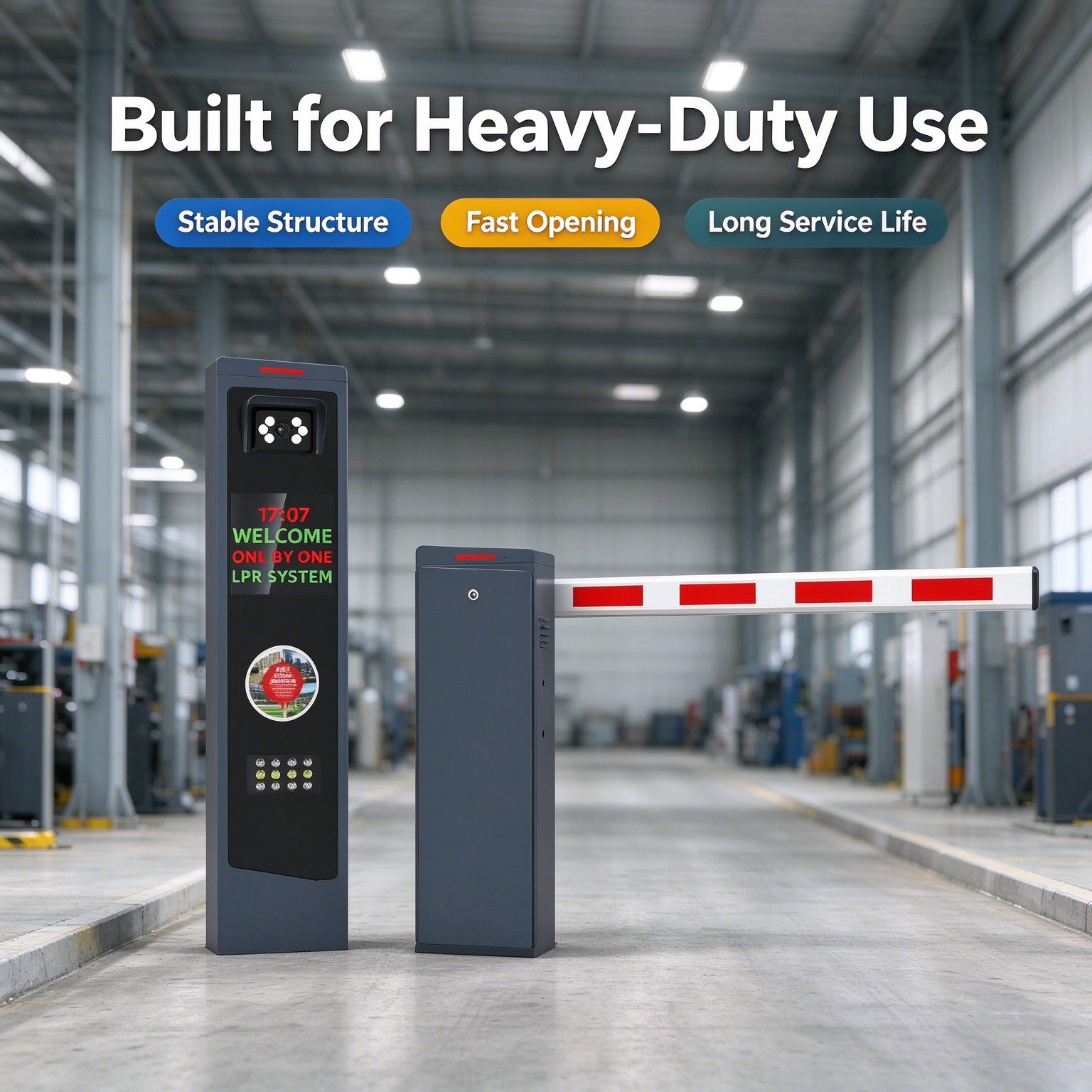
In Qatar, these requirements may exist in Doha Commercial Towers, residential complexes in Lusail, hotels, malls, and employee parking lots. Before requesting a quote, physically measure the site, determine peak times and how to check vehicles, then compare barrier models based on their technical data rather than price alone.
1. Start by measuring the clear height and obstructions
The most important step in underground parking is to measure the clear height at the barrier installation location and along the boom travel path. Check ceiling height, pipes, ventilation ducts, sprinklers, lighting, signage, and any other obstructions. Measuring the height of the entrance alone is not enough; The space required by the arm during raising and lowering must be verified and that it does not conflict with vehicles or equipment.
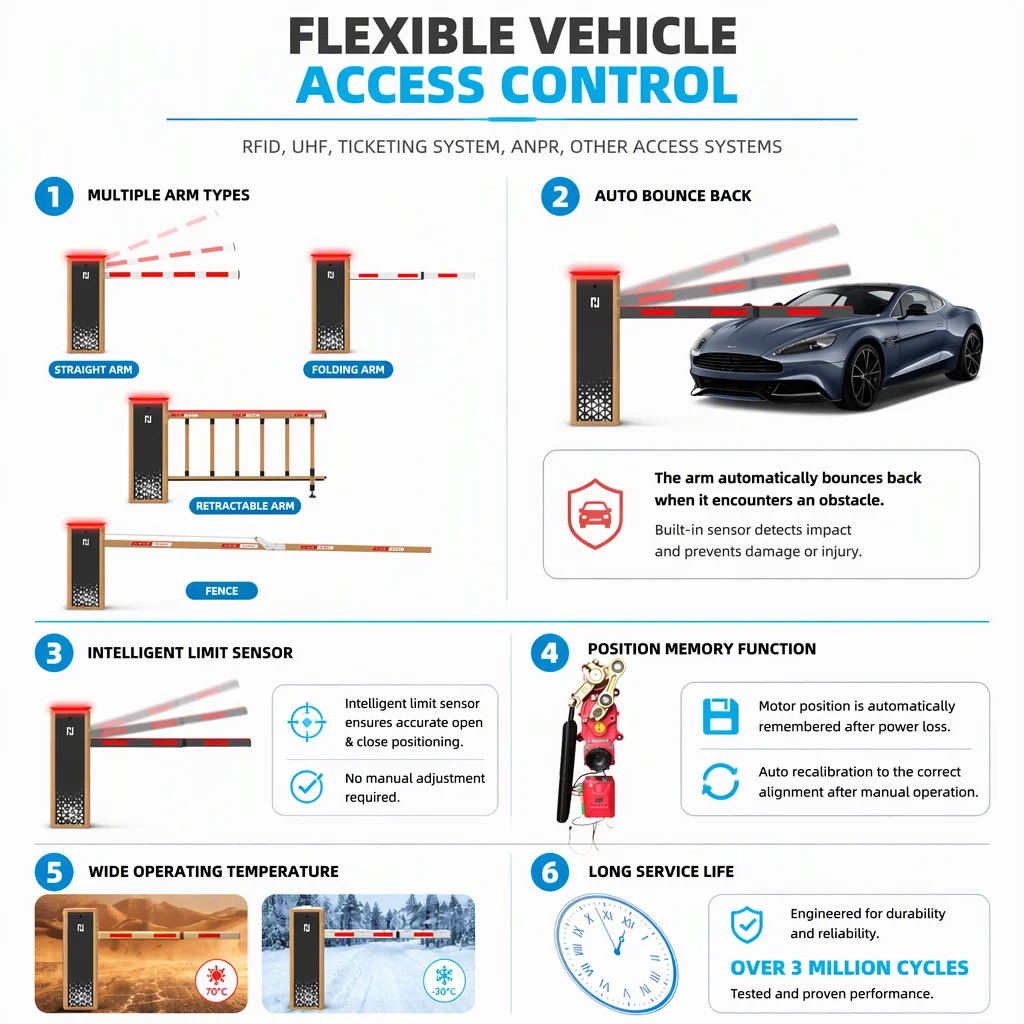
If height is limited, a 90- or 180-degree folding arm may be an option worth considering, provided the model supports this and space allows for its movement. A straight arm may be appropriate when there is sufficient vertical space. Boom type, length and movement mechanism must be confirmed with the site plan and manufacturer's specifications before purchase.
2. Choose the appropriate arm length for the track
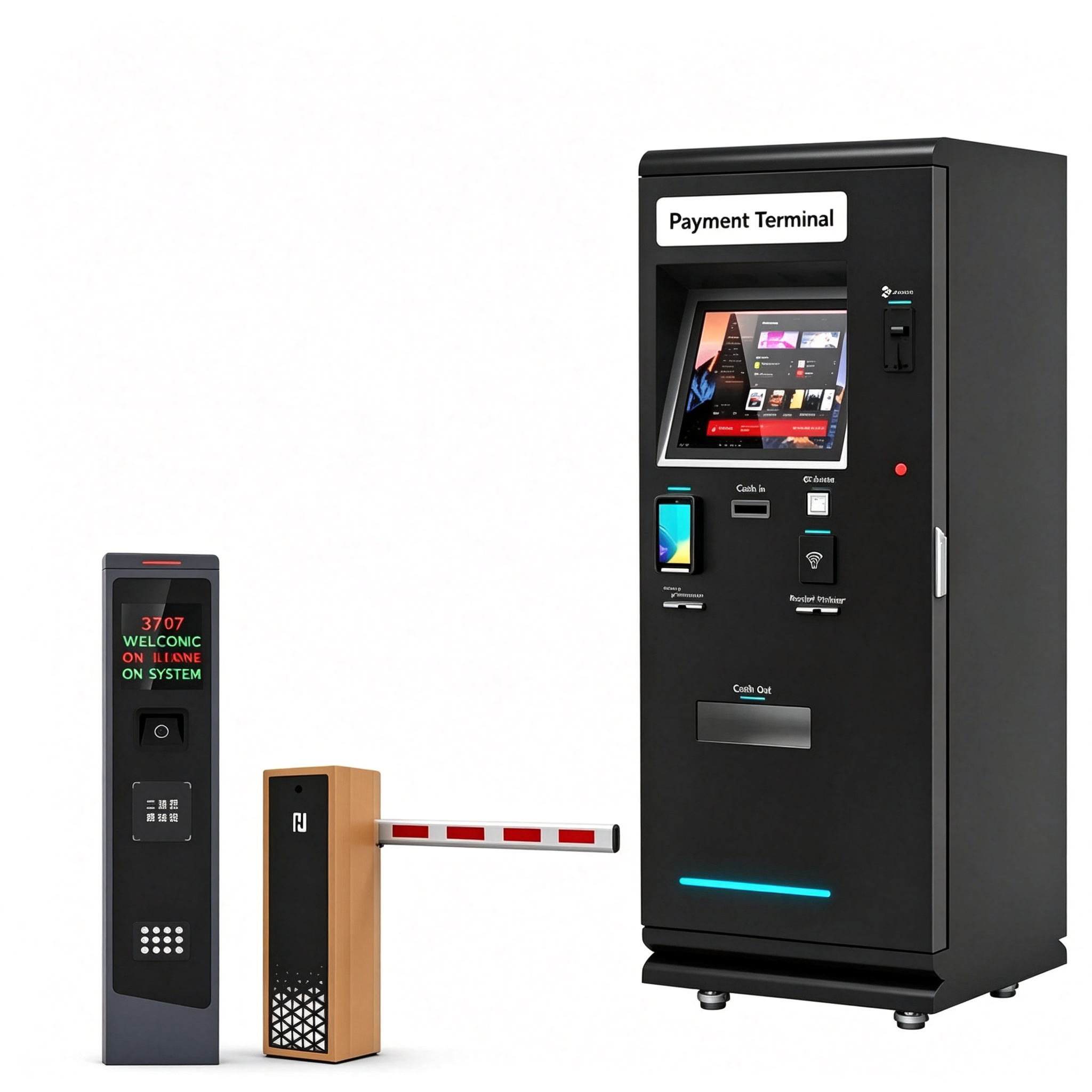
Measure the width of the path between edges or walls, and determine whether the entrance is one path or two separate paths for entry and exit. Qatar Boombarrier categories offer barriers in different lengths and shapes, including straight booms, folding booms and fence booms; But the actual length range depends on the model. Do not choose an arm that is too long, as length affects the requirements for balance, movement and available space.
On tight slopes or turns, review the position of the barrier locker, the vehicle stop line and sight distance before the checkpoint. The driver must be able to see the arm and the traffic light clearly, and must have enough space to stop without obstructing the movement of vehicles coming from behind him.
3. Calculate traffic density and waiting time
Determine the number of vehicles during peak hours and the number of daily opening and closing cycles. The parking lot of a commercial tower or shopping center may need frequent operation at the beginning and end of work, while the movement of a residential parking lot may be more distributed throughout the day. In busy sites, a high-speed model or a motor designed for heavy operating cycles may be considered, after verifying that the speed is appropriate for the boom length and safety level required.
Do not rely on an advertised speed figure alone. Ask the supplier for a data sheet for the model that includes the boom length supported, opening and closing times, duty cycle rating, and test and maintenance conditions. The speed of reading the card or vehicle plate and the response time of the program should also be evaluated, because the performance of the complete system is affected by all these stages and not just the movement of the arm.
4. Put safety at the forefront of specifications
In an underground parking situation, the driver may stop under the arm due to lane congestion or waiting for the vehicle in front of him. Therefore, detection and protection devices that are compatible with the barrier must be chosen, such as a radar sensor, vehicle detection ring, or protection methods recommended by the manufacturer. The detection area should be set so that the arm does not land on a vehicle still within the danger zone, and the system tested under actual operating conditions.
Qatar Boombarrier displays a category of radar sensors used to detect the presence of vehicles and help prevent locking of the arm on the vehicle. However, the presence of a sensor alone is not enough to ensure safety; The result depends on choosing the correct device, its installation location, connections, control unit settings, and periodic tests.
Pedestrian traffic must also be separated from the vehicle path as much as possible, especially at elevators, stairs and emergency corridors. Do not use the barrier arm as a substitute for a pedestrian gate or independent pedestrian control system, and review the building's safety, fire and evacuation requirements with the relevant consultant.
5. Choose the access control method
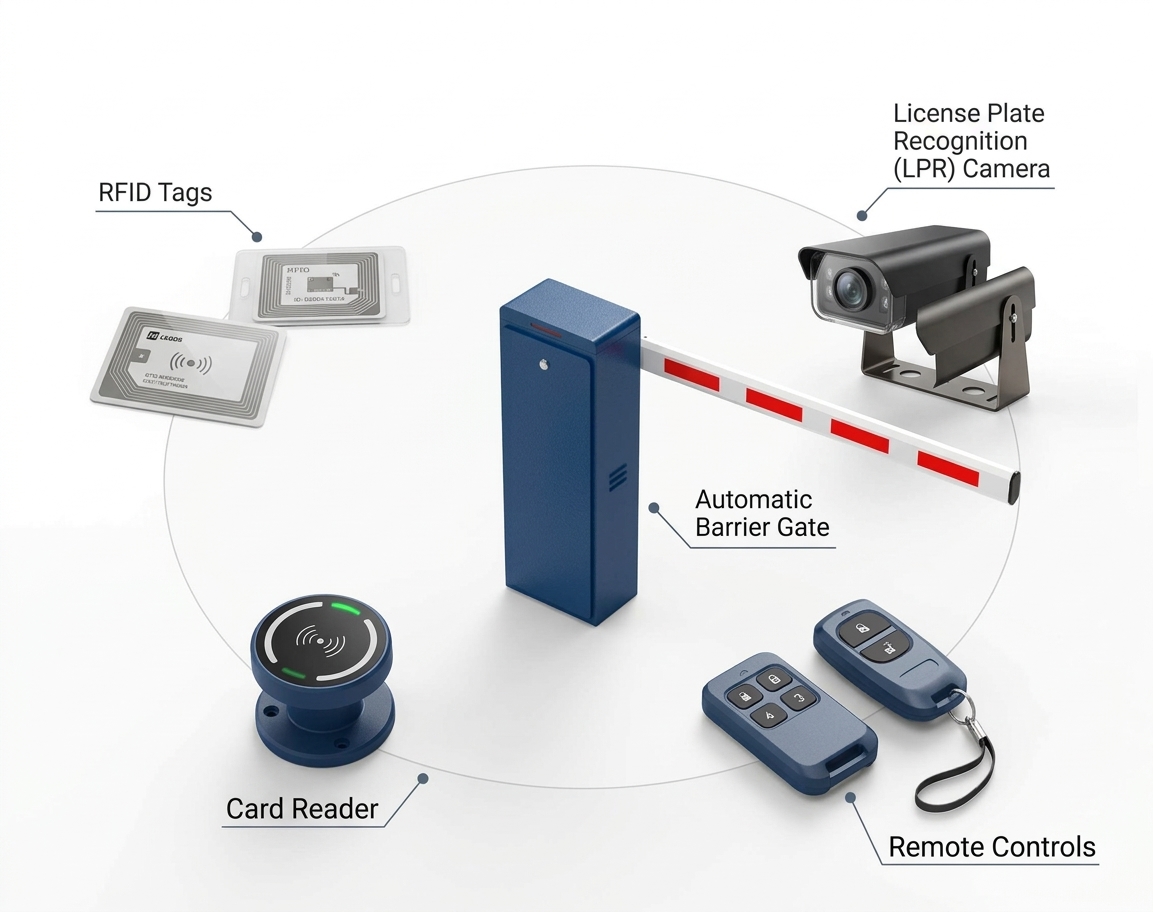
The verification method varies depending on the type of situation. قد تستخدم مواقف السكان والموظفين بطاقات RFID أو قارئ UHF بعيد المدى، بينما قد تستفيد مواقف الزوار أو المواقف التجارية من كاميرات التعرف على لوحات المركبات ANPR/LPR أو أنظمة التذاكر والدفع. توفر Qatar Boombarrier فئات تشمل حواجز RFID وأنظمة قراءة اللوحات وحلول التحكم في الدخول، ويجب التأكد من توافق كل مكوّن مع وحدة التحكم وبرنامج المواقف.
To minimize vehicles stopping at the checkpoint, the actual reading range of the plate recognition system or long-range RFID, camera angle, lighting conditions, vehicle speed, and method of authorized list management should be evaluated. In an underground environment, the effect of low light, reflections, slope angle and panel dirt on reading accuracy should be examined, with field testing performed prior to certification.
6. Make sure communications and software are compatible
Before purchasing, determine whether the barrier will operate independently or connect to parking management software, building system, payment gateway, or security platform. Request a list of interfaces supported on the proposed model, such as relay inputs and outputs, RS485, Wiegand, or TCP/IP where applicable, and ensure that the required integration is documented in the technical proposal.
Do not assume that all models support all interfaces or software functions. Agree on each party's responsibility for the integration, and test for granted and denied access, network outages, panel read failures, manual labor, and power outage recovery.
7. Review basement installation requirements
The position of the barrier must be chosen so that it does not impede the movement of vehicles and does not reduce turning space or visibility. Review the base mounting location, cable route, and access to the bulkhead cabinet for maintenance purposes, and to protect equipment from vehicle collisions. Electrical and communications works should also be coordinated with the parking and security systems contractor before starting implementation.
If the entrance is subject to water accumulation or frequent washing, check the protection rating, installation position and water drainage according to the building design. Do not transfer protection ratings from one model to another; Specifications should be based on the specific equipment data sheet and actual site conditions.
8. Calculate the total cost and maintenance
Your budget is not limited to the price of the boom barrier. Include controller, sensors, RFID reader or ANPR/LPR camera, software, cabling, base work, installation, testing, training and spare parts. Request clarification of the warranty duration, covered parts, availability of spare parts, and remote or on-site technical support procedures.
In situations with long hours, ease of maintenance and availability of parts may be more important than the initial price difference. Request a periodic inspection plan that includes installing the arm and base, testing sensors, reviewing connections, cleaning equipment according to manufacturer instructions, and recording malfunctions and repairs.
Checklist before choosing a barrier
- Measure net height and obstacles on the arm's path.
- Measure the width of the track and determine the arm type and length.
- Estimating peak traffic and the number of daily operating cycles.
- Determine vehicle detection and protection devices required.
- Choice of entry method: RFID, ANPR/LPR, tickets or others.
- Confirm communication interfaces and compatibility with the parking program.
- Review site conditions, maintenance and accessibility of the equipment.
- Request technical data sheet, warranty and availability of spare parts.
- Complete system testing before delivery.
Frequently asked questions
Is a folding arm better for underground parking?
It may be appropriate when ceiling, piping or fixtures limit straight arm movement, but the decision depends on net height, available space, arm length and model. A field measurement should be performed before selection.
Can a high-speed barrier be used in an underground parking lot?
It may be considered if traffic volume justifies it and the model is suitable for the track, arm and safety requirements. The actual operating time of the entire system, including vehicle verification, should be evaluated, not just the arm speed.
Do I need a radar sensor or ground detection loop?
It depends on the design of the entrance, barrier, console and safety requirements. A radar or detection ring can help detect vehicles, but the compatible device must be selected, installed, adjusted and tested according to the manufacturer's instructions.
Can the barrier be linked to a license plate reading camera?
Yes, if the barrier, controller and software support the required integration with ANPR/LPR. The camera's performance should be checked in lighting, approach angle, and actual speed within the situation.
Conclusion
Selection of a basement parking barrier in Qatar depends on clear height measurement, path width, boom type, traffic density, safety sensors, vehicle verification method, and compatibility with parking regulations. Qatar Boombarrier offers categories of boom barriers, high-speed barriers, RFID, ANPR/LPR and radar sensors, but exact specifications vary by model. Request a technical data sheet, review the site plan, and test integration and safety before approving your purchase.
Call to Action: Share the parking entrance plan, clear height, lane width, and expected traffic volume with the Qatar Boombarrier team to request a suitable technical recommendation.
For more details on related products and systems, see Boom Barriers and Parking Gates.
Latest News
What Is the Best Parking Barrier for a Small Car Park?
How to choose a parking barrier for a small car park in Qatar, comparing arm length, duty cycle, RFID, ANPR/LPR, safety sensors and installation cost.
2026-10-29
How to Choose the Right Automatic Parking Barrier for Your Site
A practical guide to choosing the right automatic parking barrier in Qatar, covering arm length, operating speed, traffic density, RFID and ANPR systems, safety sensors and install...
2026-10-29
How to Choose a Parking Barrier for an Underground Car Park
A guide to choosing a parking barrier for underground car parks in Qatar, covering ceiling clearance, arm type, traffic density, safety sensors and RFID or ANPR/LPR access control.
2026-10-29
How to Compare Parking Barrier Manufacturers and Suppliers
A practical guide to comparing parking barrier manufacturers and suppliers in Qatar, covering product quality, RFID and ANPR compatibility, safety, warranty, support and total cost...
2026-10-29
What Should You Consider When Buying a Heavy-Duty Parking Barrier?
A buying guide for heavy-duty parking barriers in Qatar, covering duty cycles, arm length, motor type, dust and heat protection, safety sensors and RFID or ANPR/LPR integration.
2026-10-29
How Does an Automatic Parking Barrier System Work?
Discover how an automatic parking barrier system works in Qatar, from vehicle detection and RFID or ANPR/LPR verification to safe arm opening, closing and parking management integr...
2026-10-29
Qatar Boombarrier® | Leading Boom Barrier Manufacturer
Advanced Security Access Control and Intelligent Parking Solutions.
Company Strength
Adequate Inventory
Fast Shipping
Our Products
CONTACT US
Address: No. 2 Wanshou Road, International Innovation Industrial Park, Jinan, Shandong, China


© COPYRIGHT 2025 Qatar Boombarrier® | Leading Boom Barrier Manufacturer

Contact Us
Our passion is to bring your ideas to life. Work with our design team to create a one-of-a-kind custom finish or cladding system to create a truly unique space. Together we can make your story stand out. If you need something to request a sample, request pricing, or request a demo, please fill out the contact form below. Explain your request in as much detail as you can and a representative will contact you within 1 business day.