Qatar Boombarrier® | Leading Boom Barrier Manufacturer

What Is the Difference Between RFID and ANPR Parking Systems?
Release time:
2026-10-29
The choice of vehicle access control system depends on the method of vehicle recognition, the nature of users, traffic volume, and security and management requirements. Two of the most commonly used options are RFID and Automatic License Plate Recognition (ANPR), also referred to as LPR. Both can be combined with an automatic parking barrier, but they do not work the same way and are not equally suitable for all locations.
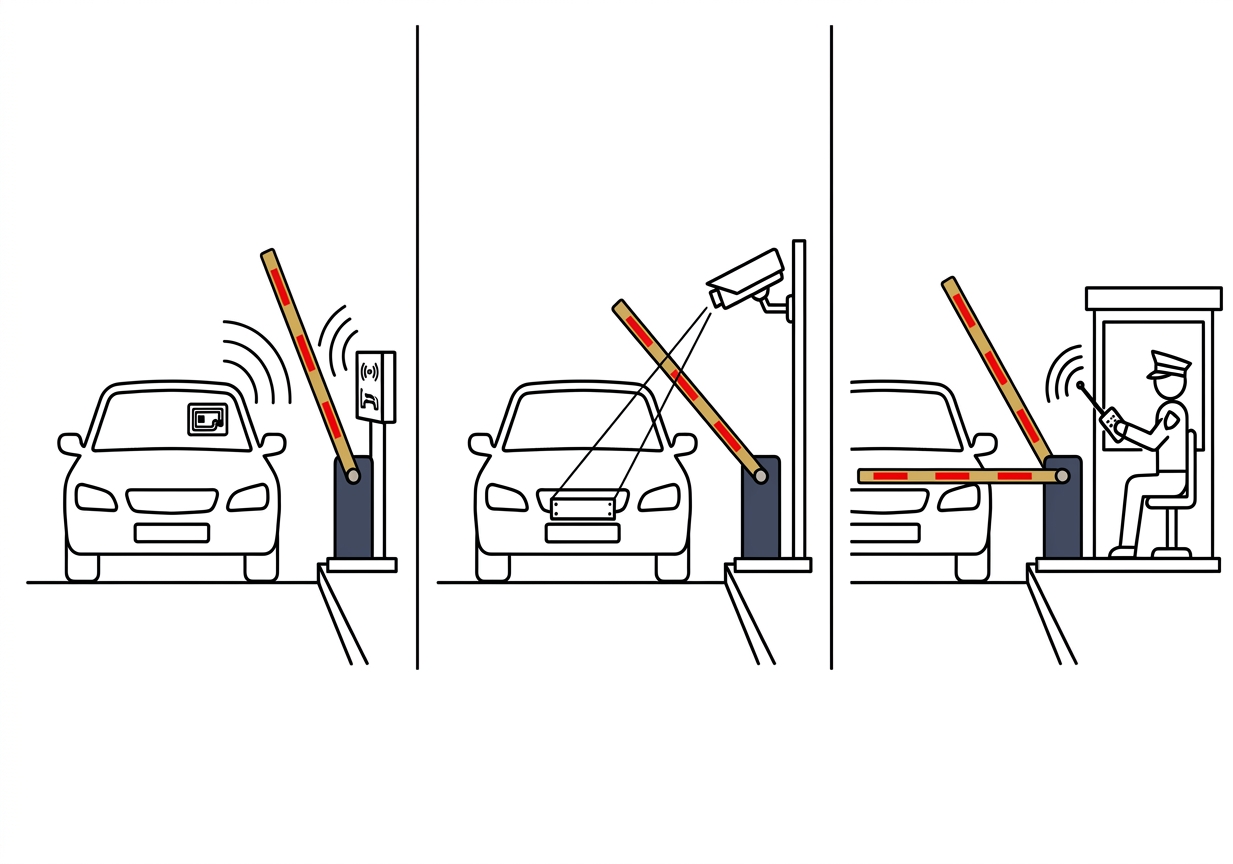
In Qatar, parking lots for commercial towers, residential complexes, offices, warehouses and logistics sites may need to balance speed of entry and ease of managing permits and recording vehicle movement. This guide explains the practical differences between RFID and ANPR, how to choose the right system, and when a combination of the two is a useful option.
Quick Answer: What's the basic difference?
- RFID: The system recognizes an authorized electronic card or label via an RFID reader. In long range UHF systems, a suitable tag can be read from a greater distance depending on the reader, tag and environment.
- ANPR/LPR: A camera takes an image of the vehicle's plate, then the program processes the image to extract the plate number and compare it to the vehicle list or entry rules.
- Both: Can be linked to barrier controller and parking management system, but actual compatibility depends on model, communication interfaces and software used.
1. How does the RFID system work with parking barrier?
The user is given an RFID card or electronic sticker linked to an authorized account or vehicle. When the user approaches the reading point or passes within range of the reader, the system reads the tag ID and sends it to the console or access management software. If the permission is correct, the system sends a command to open the barrier according to the site settings.
The usage experience varies depending on the type of RFID. A tag close to the reader may require stopping the vehicle or bringing the tag closer to the reader, while a long-range UHF system can read a compatible vehicle label from a greater distance. It should not be assumed that every RFID reader allows reading from a long distance; The result depends on the specifications of the reader and tag, the location of their installation, and surrounding obstacles.
RFID is a practical option when vehicles and users are known in advance, such as employee parking, residents and registered fleets. The administration can add users or revoke their permissions, provided that the program supports the user and that card and tag data are managed correctly. To learn about the available options, you can review Automated RFID Barriers.
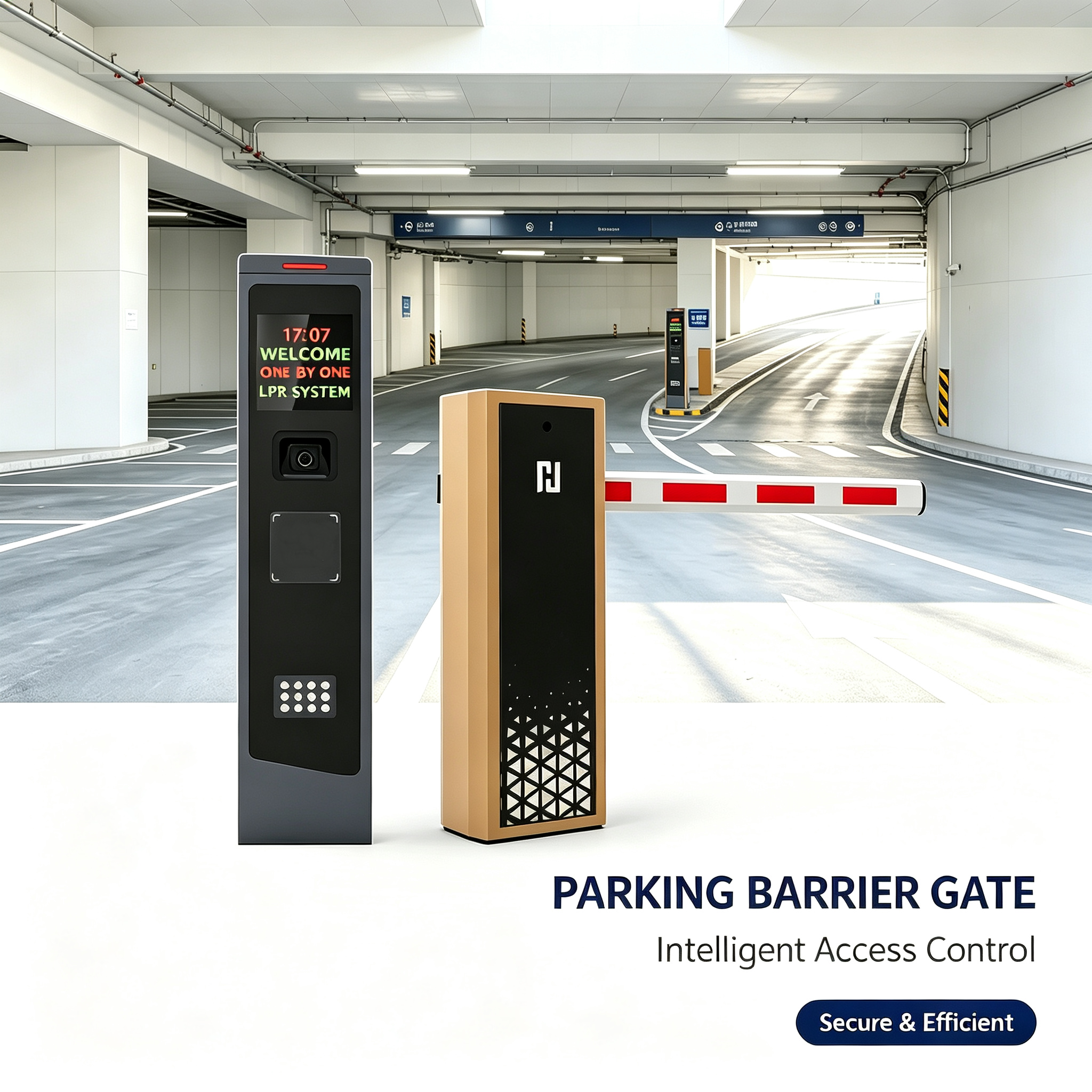
2. How does the ANPR/LPR system work?
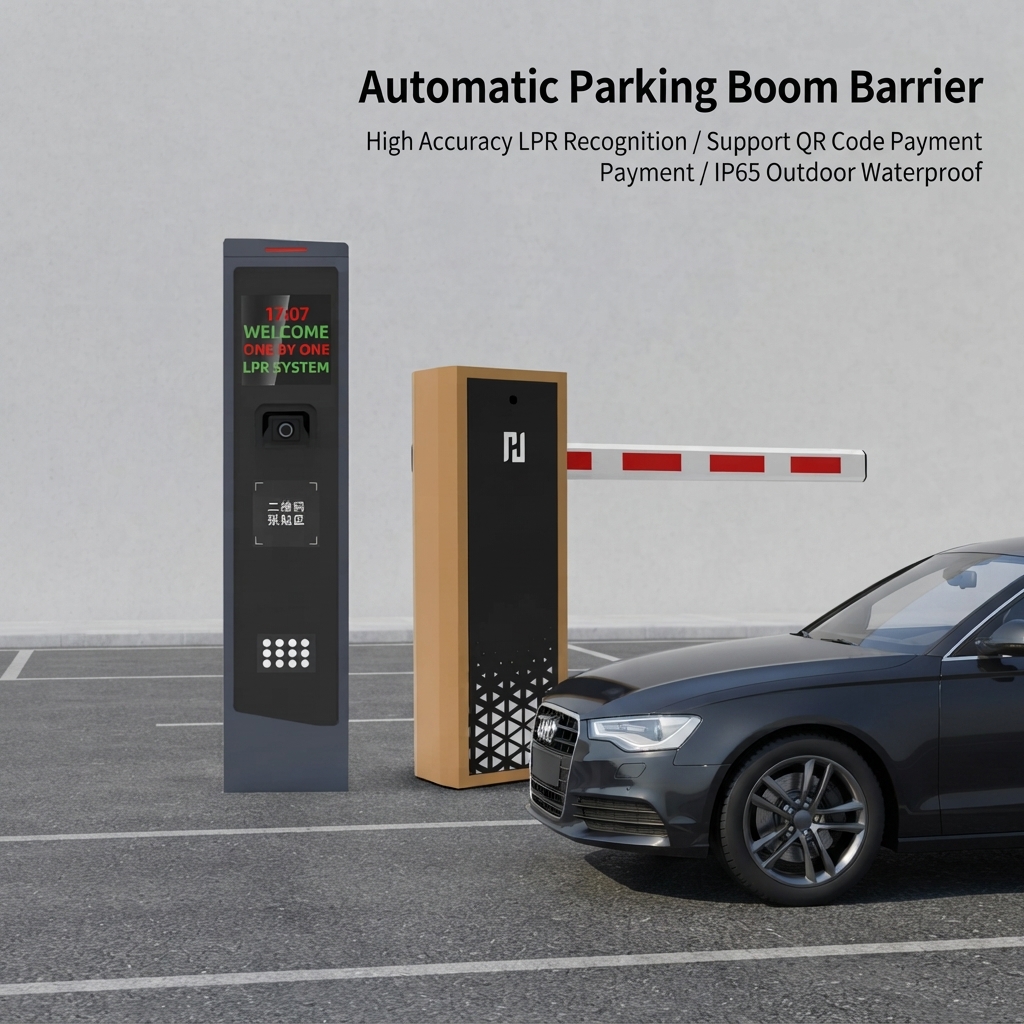
The ANPR system relies on a dedicated camera to capture the vehicle's plate at the entry or exit point. Image processing and optical character recognition (OCR) algorithms analyze the image to extract the plate number, and the software then compares the result with a list of authorized vehicles or approved entry rules. When the conditions are met, the system can send a command to the boom barrier to open it.
This method allows the vehicle to be identified without requiring the driver to show the RFID tag, provided that the plate is visible and the camera, lighting, angle and software are appropriate for the location. The result may be affected by dirty, obscured or damaged panels, glare, shadows, reflections, speed, and different panel formats; Therefore the performance must be tested in actual operating conditions.
ANPR is useful in situations that receive constantly changing visitors, customers, or vehicles, or when management needs an entry and exit record linked to the plate number. It can be integrated with parking software, payment or ticketing systems, and a compatible automated barrier. However, it should not be assumed that the camera alone handles all management functions; The system may require a program, a control unit, a network connection, and correct setting of access rules.
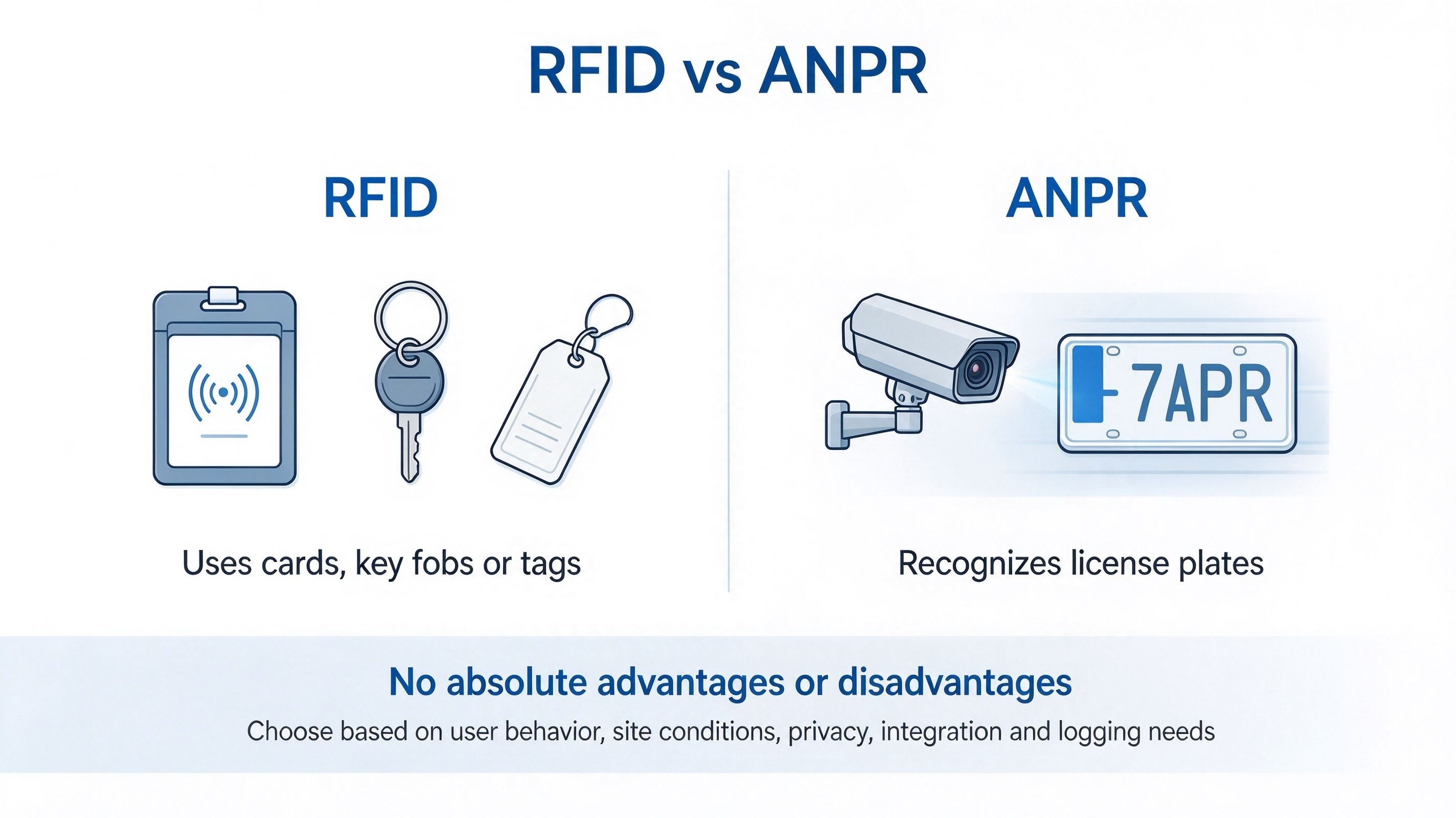
3. Compare RFID and ANPR side by side
| Comparison standard | RFID | ANPR/LPR |
|---|---|---|
| Recognition method | Card or electronic label | Image of the vehicle plate and its analysis |
| What the driver needs | Compatible label or tag, depending on design | Usually no card needs to be presented if the plate is readable |
| Best common use | Residents, employees and registered fleets | Visitors, customers and vehicles are constantly changing |
| Relying on the painting | It does not depend on reading the vehicle plate | Depends on panel clarity, camera performance and software |
| Permits management | Manage and cancel cards and tags | Managing plate numbers and entry rules |
| Site requirements | Suitable reader, compatible tags, and correct installation location | Suitable camera, angle, lighting, network and compatible software |
| Operating considerations | The card is lost, the tag is shared, or it is poorly installed | An obscured or unclear panel or an incorrect reading |
| integration | It depends on the reader, controller and interfaces | Depends on camera, software, controller and interfaces |
4. Which of the two systems is faster at the parking gate?
There is no single answer that applies to all sites. A well-designed long-range RFID system can enable a registered vehicle to be identified before it reaches the barrier, reducing the need to stop. The ANPR system can allow entry without a card, but the processing time is affected by the image quality, recognition speed, software connection, and verification of validity.
In locations with heavy traffic, evaluate the full cycle time and not the recognition time alone. This includes approaching the vehicle, checking validity, opening the lever, crossing the vehicle, and then safely closing the barrier. It is also necessary to take into account the length of the arm, the speed of the specified barrier, the distance between vehicles, the efficiency of the sensors, and to prevent the barrier from being opened for an unauthorized vehicle.
5. Which is safer?
Recognition technology alone does not make it the only security standard. In RFID, tags and tags must be protected from loss or unauthorized sharing, and the tag must be invalidated immediately when it is lost or no longer needed. Protection can be supported by time validity rules, access logs, and periodic review of users, according to the capabilities of the system.
In ANPR, lists of permitted plates should be adjusted, cases of rejection or misreading should be reviewed, and who can access vehicle records should be determined. Unclear cases may require human review or an alternative method of identity verification. The system must be designed so that failure of communication or reading does not automatically lead to unsafe opening of the barrier.
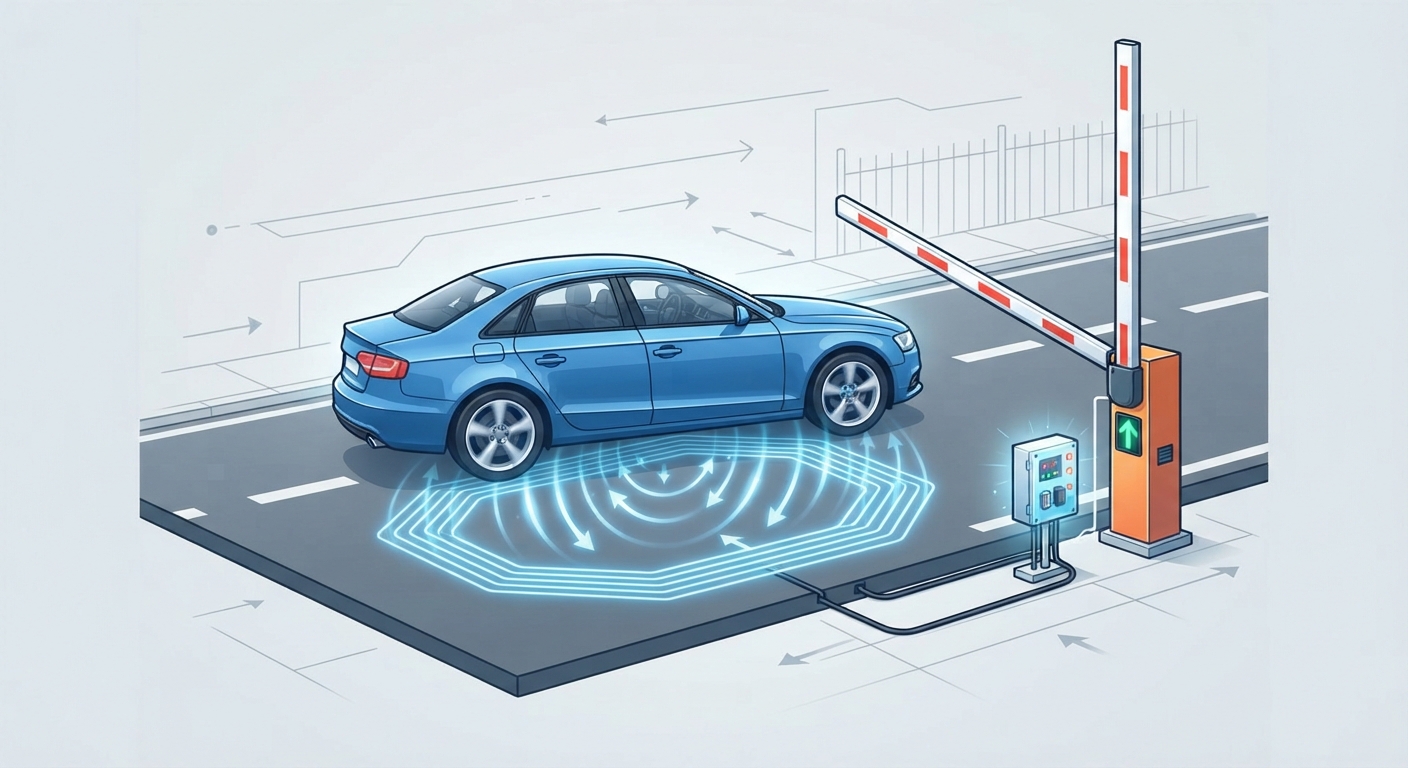
In both systems, mechanical and electrical safety measures remain essential. Vehicle detection loops, radar sensors, and other compatible protective devices should be evaluated, installed and adjusted in accordance with the manufacturer's instructions, and tested regularly. RFID or ANPR technology is not a substitute for obstacle detection or pedestrian safety measures.
6. Cost: What should be compared?
The cost of RFID is affected by the type of reader, the reading range required, the number of cards or tags, the method of installing them, and the integration of the system with the barrier and parking software. Management may be easy on sites with a stable group of users, but the cost of issuing cards and tags, replacing lost ones, and managing permissions must be calculated.
As for ANPR, the cost includes, depending on the configuration, the camera, lenses or auxiliary lighting, processing unit or software, storage, network, integration and technical support. The need to improve lighting, change the camera angle, or add an alternative path when the sign cannot be read should also be evaluated. Request a quote that outlines components, licensing, configuration and maintenance, rather than comparing the price of the camera alone to the price of the RFID reader.
7. Can RFID and ANPR be combined into one system?
Yes, on some projects RFID and ANPR can be used together, if the barriers, controllers and software support this configuration. For example, RFID can be used for registered vehicles entering daily, while ANPR is used to identify visitors' vehicles or to record the plate number as an additional layer of verification. But the decision rules must be clearly defined so that the two systems do not conflict or open a barrier based on an incomplete result.
Before adopting a dual solution, determine when RFID alone should be accepted, when the card must be matched to the vehicle's license plate, and how to handle a visitor, alternate vehicle, camera failure, or loss of communication. Ask the vendor for an integration and acceptance test diagram that shows entry, exit, and exception scenarios.
Qatar Boombarrier offers categories of robotic boom barriers, RFID barriers, ANPR/LPR systems, and radar sensors. The appropriate configuration is chosen according to the project requirements; Therefore compatibility of the selected model with the reader or camera and parking management software should be confirmed before purchase.
8. How do you choose the appropriate system for your site in Qatar?
Choose RFID if:
- Most of the vehicles were already registered, such as those of residents or employees.
- You want to manage the permissions of cards or tags in a straightforward way.
- Tags could be distributed, managed and updated regularly.
- The type of reader and reading range were appropriate to the design of the entry.
Choose ANPR/LPR if:
- The site was receiving a variable number of visitors or customers.
- You need to log in and out using your plate number.
- You want to reduce your reliance on physical cards.
- The plates were clearly viewable and an appropriate shooting angle and lighting could be provided.
Consider the two systems together if:
- You have different categories of users, such as residents, employees, visitors, and suppliers.
- An additional layer of verification was needed for some vehicles or entries.
- The parking management software was able to consolidate the data and apply clear rules.
- The budget and infrastructure were to allow for ongoing integration and maintenance.
9. Questions to ask the supplier before purchasing
- Does the specific barrier model support RFID reader, ANPR/LPR camera, or both?
- What is the actual RFID reading distance under site conditions, and what type of tag is required?
- What types of panels can the ANPR system recognize in a project, and how is accuracy tested?
- Does the system integrate with existing parking software, and what interfaces are supported?
- How does the barrier behave when the network is interrupted or the card or board cannot be read?
- What vehicle and obstacle detectors are compatible with the configuration?
- What are the components of the offering, licensing, configuration, maintenance and warranty costs?
- How are access logs and plate images stored, and who can access them?
Frequently asked questions
Is RFID better than ANPR for residents' parking?
RFID may be appropriate if vehicles are registered and users are known, while ANPR may be more appropriate if management needs to record vehicle movement by plate or facilitate entry for visitors. The decision depends on the operating mechanism, budget, and required integration.
Does the ANPR system need an RFID card as well?
Not necessarily. ANPR can operate under an authorized panel list if the camera, software and controller are configured. RFID can be added when an additional verification method is needed or to cover situations where plate reading is not suitable.
Can the RFID system open the barrier without stopping the vehicle?
A long range UHF reader may allow this if the reader, tag, path and settings are appropriate. As for nearby RFID cards, this may require bringing the card closer to the reader or stopping the vehicle. The actual reading distance must be checked on site.
Does ANPR recognize every plate in all conditions?
no. The result depends on plate clarity, shooting angle, lighting, speed, plate condition, and camera and software performance. Field testing should be conducted under expected day, night, and crowding conditions, with an alternative procedure in place for unreadable situations.
Can RFID or ANPR be linked to a robotic arm barrier?
Yes, if the system components are compatible and support the required controller and communication interfaces. Each device's specifications, connection diagram, control rules and safety testing must be reviewed before operation.
Conclusion
The basic difference is that RFID recognizes an electronic card or tag, while ANPR/LPR recognizes a vehicle's plate via a camera and software. RFID is mostly practical for users and registered vehicles, while ANPR is suitable for locations that need to recognize plates and record changing vehicle movements. Combining the two may provide additional flexibility when the technical architecture supports it and the management rules are clear.
Don't choose a system based solely on the advertised recognition speed or the price of an individual device. Evaluate actual traffic, type of users, lighting and signage conditions, data security, integration with barrier and parking software, safety sensors, and maintenance plan. Qatar Boombarrier offers options of robotic boom barriers, RFID, ANPR/LPR and radar sensors; Compatibility and specifications must be confirmed with the technical team according to the project requirements.
Call to Action: Prepare information on location type, daily vehicle count, ratio of registered vehicles and visitors, and current access management method, then request a technical recommendation for the appropriate RFID, ANPR, or embedded solution configuration.
For more details on related products and systems, see Boom Barriers and Parking Gates.
Latest News
What Is the Best Parking Barrier for a Small Car Park?
How to choose a parking barrier for a small car park in Qatar, comparing arm length, duty cycle, RFID, ANPR/LPR, safety sensors and installation cost.
2026-10-29
How to Choose the Right Automatic Parking Barrier for Your Site
A practical guide to choosing the right automatic parking barrier in Qatar, covering arm length, operating speed, traffic density, RFID and ANPR systems, safety sensors and install...
2026-10-29
How to Choose a Parking Barrier for an Underground Car Park
A guide to choosing a parking barrier for underground car parks in Qatar, covering ceiling clearance, arm type, traffic density, safety sensors and RFID or ANPR/LPR access control.
2026-10-29
How to Compare Parking Barrier Manufacturers and Suppliers
A practical guide to comparing parking barrier manufacturers and suppliers in Qatar, covering product quality, RFID and ANPR compatibility, safety, warranty, support and total cost...
2026-10-29
What Should You Consider When Buying a Heavy-Duty Parking Barrier?
A buying guide for heavy-duty parking barriers in Qatar, covering duty cycles, arm length, motor type, dust and heat protection, safety sensors and RFID or ANPR/LPR integration.
2026-10-29
How Does an Automatic Parking Barrier System Work?
Discover how an automatic parking barrier system works in Qatar, from vehicle detection and RFID or ANPR/LPR verification to safe arm opening, closing and parking management integr...
2026-10-29
Qatar Boombarrier® | Leading Boom Barrier Manufacturer
Advanced Security Access Control and Intelligent Parking Solutions.
Company Strength
Adequate Inventory
Fast Shipping
Our Products
CONTACT US
Address: No. 2 Wanshou Road, International Innovation Industrial Park, Jinan, Shandong, China


© COPYRIGHT 2025 Qatar Boombarrier® | Leading Boom Barrier Manufacturer

Contact Us
Our passion is to bring your ideas to life. Work with our design team to create a one-of-a-kind custom finish or cladding system to create a truly unique space. Together we can make your story stand out. If you need something to request a sample, request pricing, or request a demo, please fill out the contact form below. Explain your request in as much detail as you can and a representative will contact you within 1 business day.